The Story of Flax — Linen
The smart, green,
sustainable fibre.
From a flax flower in a quiet European field to a finished bolt at our Banbridge mill — a 120-day journey, told in full.
Production leadership
Europe is first in the world for quantity and quality — with ethical production by a skilled local workforce, in compliance with the rules of the International Labour Organization.
97,000
hectares of European flax under cultivation
133,000
tonnes of long fibres harvested annually
80%
of the world's flax production
Source: 2015 Harvest figures – 2015/2016 Campaign, CELC Cultivation-Scutching, Sept. 2016
Flax cultivation
120 days. Nine milestones.
From the first turning of the soil in early March to the great rolled balls of retted flax in August — a single growing season tells the entire story.
01
Early March
Soil preparation
Flax is grown on a 6–7 year crop rotation that regenerates the soil for beet, wheat and potatoes that follow.
02
Mid-March – April
Sowing
Today's grower can choose between twenty or so varieties — selected by yield, lodging resistance and maturation timing.
03
April
Germination
Roots reach ten times the height of the plant. Silty soils and oceanic climate give European flax its quality.
04
May
4 to 10 cm
Bast fibres form within the stem, surrounded by a fine woody outer layer.
05
May – June
To flowering
600 mm of water across 100 days — all of it from rain (400 mm), soil reserves and dew (200 mm). Zero irrigation.
06
June
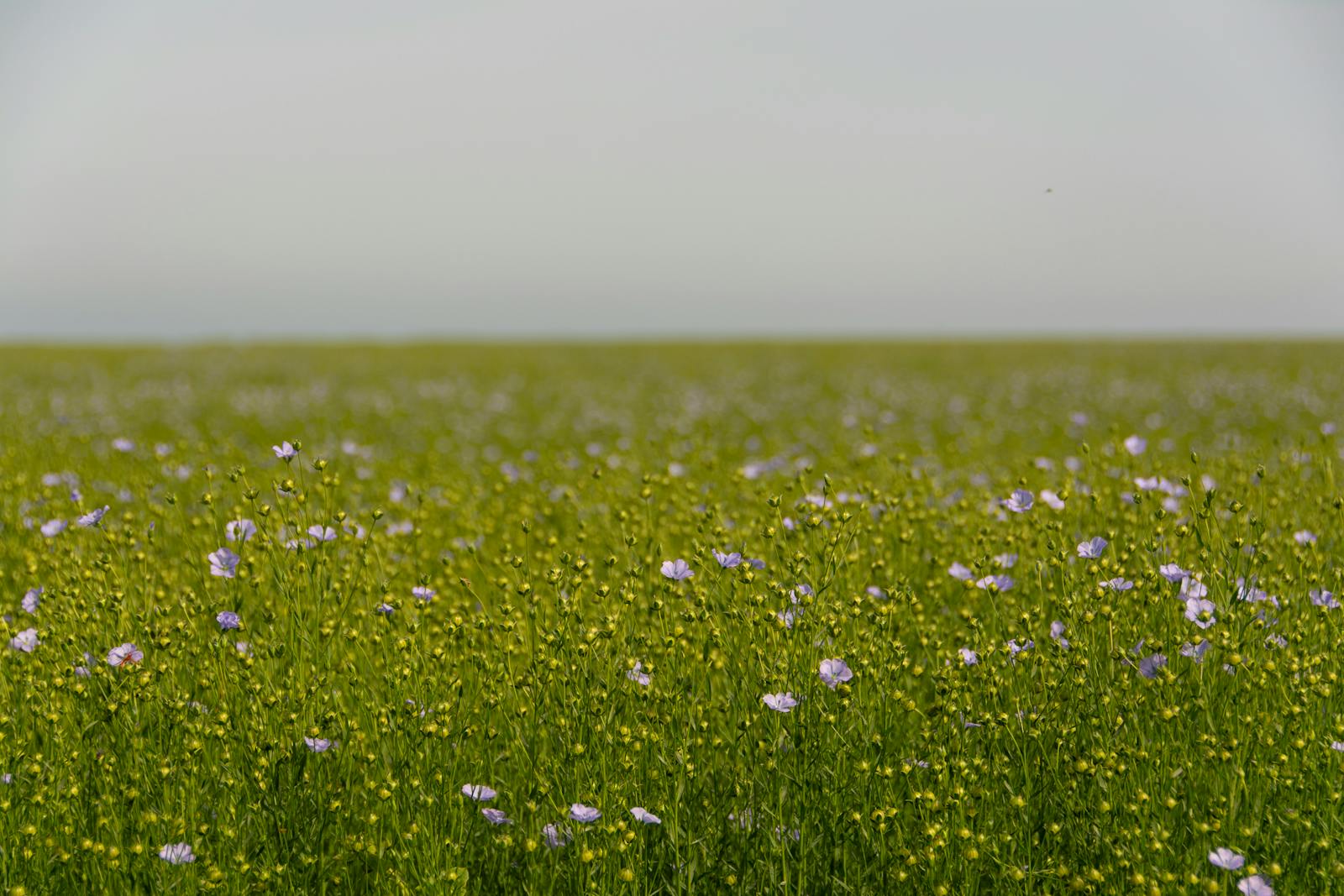
Flax in flower
Pale-blue blooms open at sunrise and close by midday. Growth accelerates 1–5 cm per day; fibre count is set.
07
July
Maturity & pulling
Five weeks after flowering, the plant is pulled — not cut — preserving the full length of the fibre. Roots stay in the ground, enriching the soil.
08
July – August
Retting
Micro-organisms in the soil and a suitable dose of rain break down the natural cement binding the fibres. Zero chemicals.
09
August
Collecting
Swathes are rolled into great balls and stocked. Properly retted flax keeps almost indefinitely without deterioration.
From plant to linen fabric
Seven steps to the bolt.
01
Scutching
Entirely mechanical separation of fibre from straw, performed on facilities sited next to the fields. No chemicals, year-round.
02
Combing
Also called hackling. The scutcher or spinner aligns the long fibres for the next stage.
03
Preparation for spinning
Slivers of combed flax from different fields, regions and years are blended — a know-how comparable to champagne and cognac. The finest yarns can blend up to 32 batches.
04
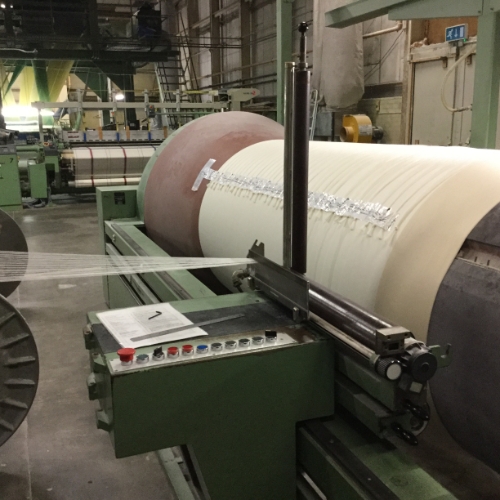
Spinning
Fine apparel yarns: "wet" spinning, fibres immersed in water at 60 °C for fineness. More rustic yarns: "dry" spinning, for decoration and rope.
05
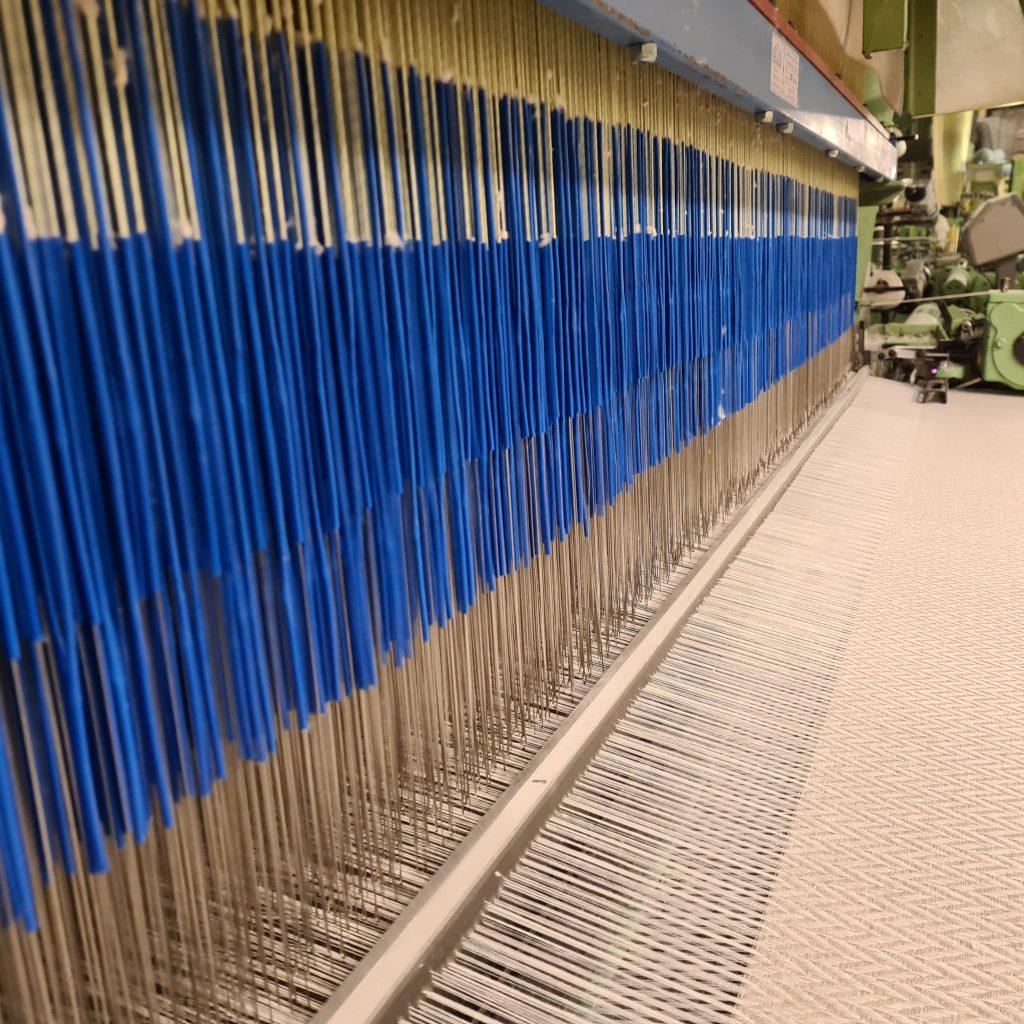
Weaving
Crisscrossing of warp and weft. Plain, twill, herringbone, satin, crêpe, jacquard, damask, terrycloth, velvet — linen has freed itself from trends to become synonymous with innovation.
06
Finishing
John England specialises in a pre-shrunk, sustainable soft-wash finish. All finishing now happens at our Banbridge factory — greatly reducing the carbon footprint.
07
Soft Washed linen
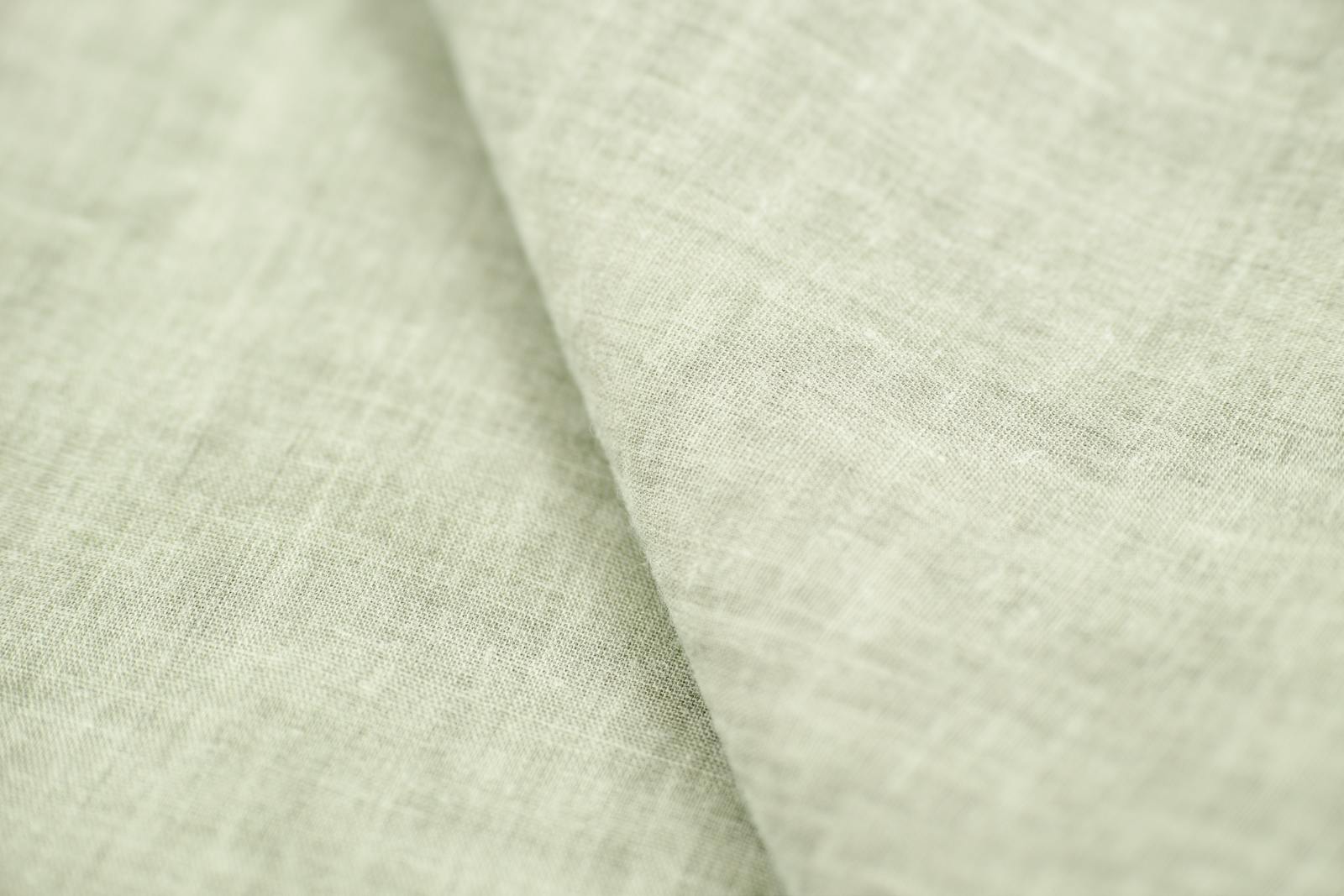
A combination of finishing technologies. The result: a cosy, soft handle and a supple texture that doesn't require ironing.
“Linen has freed itself from the vagaries of trends to become synonymous with innovation.”
A natural exception
A welcome environmental pause for the planet — and for humankind.
Flax and hemp need less fertiliser and fewer chemical pesticides than the crops they replace. They have positive effects on agricultural diversity and the landscape — a benefit confirmed by the European Commission's own audit.
250,000 t
CO₂ stored in European agriculture every year — flax is a carbon sink.
0
Litres of irrigation. Rain alone is enough.
0
Waste. Every part of the plant is used or transformed.
342,000 t
Greenhouse gas emissions spared each year in Europe.
38,000 t
Oil-equivalent saved each year.
300 t
Phytosanitary products saved each year.
Sources: Advisory Commission's Report to the European Parliament, Brussels, May 2008 · Eco-profile of a linen shirt (Bio Intelligence Service for CELC, 2007) · The Barometer of European Flax/Linen 2015, CELC Report by BVA and BIO BY DELOITTE.
The remarkable qualities of linen
Why this fibre is built for a body.
01
Breathable
The best flow of air and vapour between skin and surrounding environment.
02
Moisture-managing
Remarkable absorbency — linen evaporates water quickly for optimal comfort.
03
Thermoregulating
Cool in summer, insulating in winter. Linen can be worn in any season.
04
Hypoallergenic
Indicated for sensitive skins. Patch tests show no allergic reaction.
05
Antibacterial
Cellulosic fibres significantly outperform synthetics in lab tests with bacteria.
06
Long-lasting
The most resistant of natural fibres. Pills very little, thanks to the long fibre length.
“Able to absorb and evaporate water quickly, linen keeps the skin dry and thus promotes sleep. Linen, as a non-allergenic fibre, prevents any discomfort; its softness helps the feeling of wellbeing — a pre-condition for sleep.”
Easy to look after
Linen is the most resistant of natural fibres.
01
Washing
Linen becomes more supple with every wash. White linen up to 95 °C; colours 40–60 °C on a normal programme. Always check the care label.
02
Whitening
Use detergents and whiteners with an oxygenated base. Avoid chlorine bleaches — these can yellow linen if not rinsed immediately.
03
Drying
After a moderate spin, dry hanging, flat (knits), or in the tumble dryer per the label. Soft-washed linen and knits don't need ironing.
04
Ironing
If needed, iron while still damp on the reverse side. Pure linen tolerates a very high temperature — but test on a corner first with dark colours.
Care guidance courtesy of COFREET — owners of the textile care symbols and the eco-friendly clevercare.info logo.
Traceability you can verify
Two marks. One Europe.
Premium qualitative standard
European Flax®
The qualitative standard of European flax fibre for all uses — fashion, lifestyle, home and composites. The European Flax® Charter, signed by every flax producer, guarantees local farming that respects the environment.
Zero irrigation · GMO-free · Zero waste
Audited by Bureau Veritas Certification, the label certifies traceability at every step of processing through to the finished product.
100% Made in Europe
Masters of Linen®
The guarantee of linen traceability — 100% made in Europe from European Flax® fibre, through to yarn, fabric and finished cloth.
A club of companies that preserves and enhances quality, creativity and local production. A laboratory of ideas and innovation. John England is a proud member.
38,000 years of cloth
A holistic experience and a sense of humanity.
36,000 BC
The first textile
Flax fibres are discovered in a cave in Caucasia — humanity's very first textile, contemporary with bone hooks.
3,000 BC
The Phoenicians
Linen is exported from the Mediterranean to Scotland, Persia, India and China.
1810
The spinning machine
Philippe de Girard develops the flax spinning machine in France — the start of the industrial revolution in linen.
1854
Thomas Ferguson
Thomas Ferguson Irish Linen Weavers established. Still operating in Banbridge today as our sister company.
1964
John England
John England Irish Linen established. Sixty years on, our looms are still running.
Sixty years and counting
From a Caucasian cave to a Banbridge loom — linen's story is still being woven.